


Q2 2026 Australian Corporate Property Market and Corporate Property Strategy Outlook
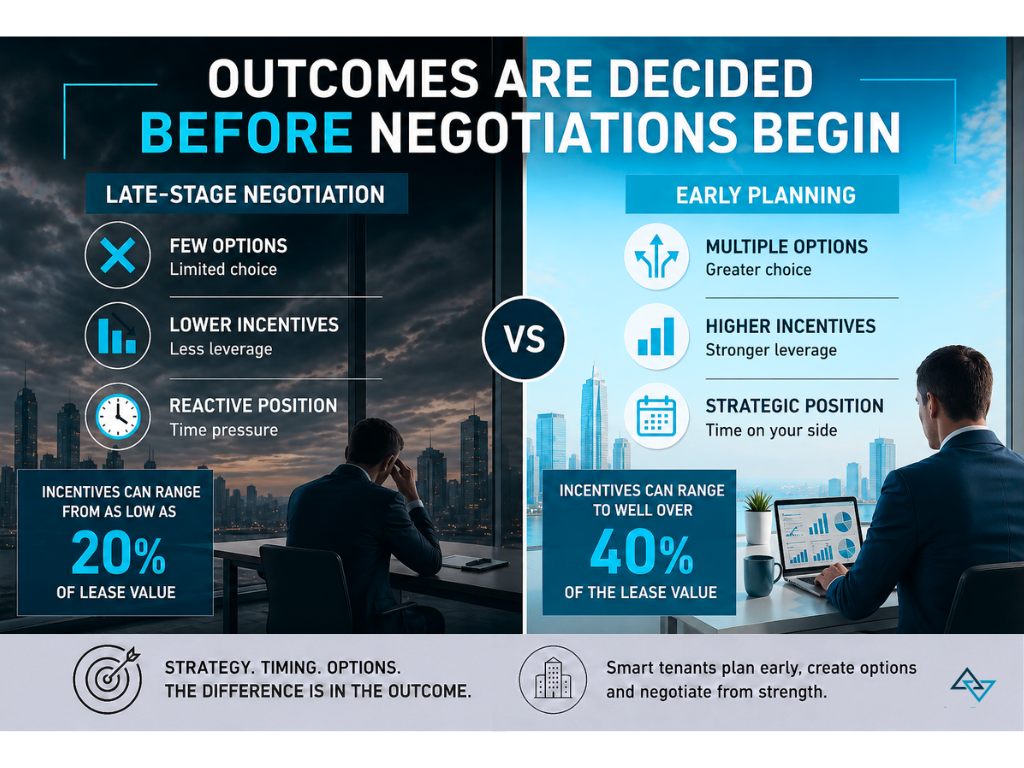
Corporate tenants consistently treat the negotiation phase as the moment that determines the quality of a lease transaction. In practice, the outcome has usually been shaped well before any offer is exchanged. Good governance in property decisions requires good questions, and in our experience, the most important questions are the ones asked earliest in the process.
“The outcome has usually been shaped well before any offer is exchanged.”
Timing Drives Outcomes, Not Just Negotiation
One of the most consistent patterns across the Australian office market is that tenants who engage early secure materially better outcomes. This is not merely anecdotal. It is reflected in market data from leading advisory firms including CBRE Australia Office Market Reports, the JLL Office Market Overview and Colliers Research Australia.
Across major CBD markets, incentives can range from as low as 20% to well over 40% of total lease value depending on timing, competition, and prevailing market conditions. The difference between achieving the upper end of that range and settling for far less is rarely a question of negotiation skill in isolation. More often, it comes down to whether the tenant created genuine leverage early enough in the process. Tenants who begin their market engagement 18 to 24 months ahead of lease expiry consistently outperform those who leave it until 12 months or fewer. By the time urgency sets in, the ability to credibly walk away from a deal has already been compromised.
“By the time urgency sets in, the ability to credibly walk away from a deal has already been compromised.”
The Deal Is Not What It Looks Like on Paper
Many organisations still evaluate leases primarily on headline rent, which is a narrow and often misleading way to assess a transaction. Two tenants can sign at the same headline rent and achieve completely different financial outcomes over the life of a lease. The real value sits in the incentives secured, the structure of the lease, how risk has been allocated between the parties, and specific clauses covering rent reviews and make-good obligations.
“A fitout contribution that appears generous on its face may be offset by restrictive make-good provisions or unfavourable review mechanisms that crystallise costs years down the track.”
The Property Council of Australia regularly highlights the complexity of commercial lease structures and the importance of understanding full occupancy costs rather than face rent alone. A fitout contribution that appears generous on its face may be offset by restrictive make-good provisions or unfavourable review mechanisms that crystallise costs years down the track. Organisations that fail to model the full economic impact of a lease, including outgoings, rent-free periods, incentive structures, and end-of-lease obligations, routinely underestimate their true cost of occupancy.
Benchmarking Can Mislead as Much as It Informs
“The question to ask is not simply how a proposed deal compares to the market average, but whether the process that produced it was genuinely competitive.”
Benchmarking is widely used in corporate property decisions, but it is frequently misunderstood and applied in ways that actually limit rather than improve outcomes. If the benchmark is constructed from average market deals, the result will, at best, be average. In some circumstances it may be considerably worse, because averages in a concentrated market tend to reflect norms that are already weighted in the landlord’s favour.
This is particularly relevant in the Australian market, where a relatively small number of institutional landlords control a disproportionately large share of prime-grade office assets across the major CBDs. Without independent validation, benchmarking can mask underperformance by normalising it, reinforce market norms that structurally favour landlords, and constrain the strategic thinking that would otherwise surface better alternatives. The question to ask is not simply how a proposed deal compares to the market average, but whether the process that produced it was genuinely competitive.
Final Thought
Good governance in property decisions requires the right questions to be asked at the right time. Not at the point of approval, when the deal has already taken its shape, but at the very start of the process, when there is still time to build leverage, test the market, and negotiate from strength. Because by the time a lease reaches the negotiation table, the outcome is often already set.